Projects
01
The two people in my life who cook the most had recipes saved in a dozen different places. Handwritten notes, Instagram saves, screenshots, bookmarked websites, physical cookbooks. They could never find what they needed when they needed it.
I built Bella, an AI-powered recipe manager for iOS, in Swift and SwiftUI. You can import a recipe from anywhere: take a photo of a handwritten card, paste a web link, or upload a screenshot. The app uses the OpenAI API to read handwriting and to extract structured recipe data from web pages, stripping out ads and filler. I had never done iOS development. I took it from concept to the App Store.
It is live on the App Store and used by my girlfriend, my mom, their family, and friends.
- Photograph
- Any handwritten recipe
- Link
- Any recipe website
- Any social media recipes
- Any saved recipe image
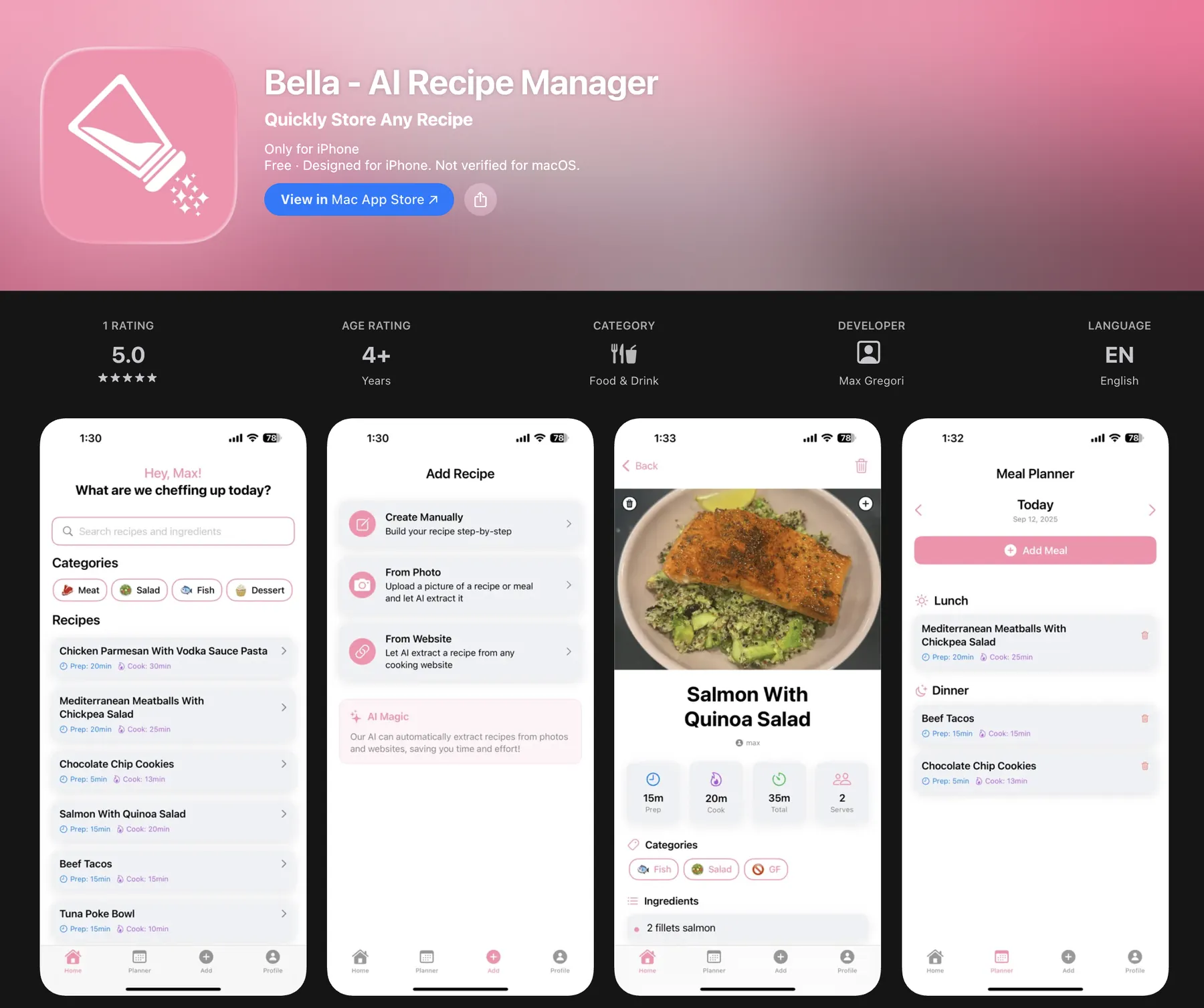
02
Prediction markets were taking off and people were claiming you could set up a trading bot overnight. That did not add up to me. I wanted to find out what it actually takes, and whether there is a real edge behind the noise.
I started from first principles: how weather data is measured, where stations source it, and how it gets hosted. I put the system in an AWS data center co-located with NOAA's weather data to keep latency down. It is Python and NumPy. It ingests real-time NWP ensemble forecasts, builds probability distributions with station-level bias correction, and trades on prediction exchanges with risk controls: exposure ramps, drawdown circuit breakers, and per-market caps. It runs on EC2, processing over 200 markets per cycle across 20 US cities, and sends me performance reports.
- 200+
- Markets per cycle
- 20
- US cities
01
NOAA data
Real-time NWP ensembles
02
Bias correction
Station-level adjustments
03
Probability model
Empirical distributions
04
Trade execution
Caps, ramps, breakers
03
Creative Pipeline
AI-generated content was taking off, and most of the conversation around it felt like hype. I wanted to understand it from the ground up: not just the end product, but how you actually get there. I took the process apart, figured out how it was made, and rebuilt it myself.
You give it a one-line premise. The system writes a scene-by-scene script, produces voiceover per scene, generates AI-animated clips, and assembles a finished video with word-synced captions, ready to publish.
01
Idea
A one-line premise
n8n
02
Script
Scene by scene
Claude
03
Voice
Narration per scene
ElevenLabs
04
Video
Generated clips
Veo 3.1 · Kling 3.0
05
Publish
Captions, then out
Creatomate · Blotato